Hawk-Eye Sector Radar: New Opportunities Beyond the Big Winners
Why High Expectations Can Become a Risk
On the stock market, a compelling growth story does not automatically translate into a good investment. The more investors are convinced of the future prospects of a company or sector, the higher the valuations and expectations often already are. In such situations, even good news may no longer be enough to drive stock prices higher.
Conversely, interesting investment opportunities can arise precisely where expectations are low. If stock prices improve despite negative market sentiment, this can be an early sign that market participants’ assessments are shifting.
The Tareno Hawk-Eye Sector Radar is specifically designed to identify such trends. It does not focus on the most popular stock sectors, but rather on those where sentiment, positioning, and price behavior are increasingly diverging.
Defensive Sectors Are Coming Into Focus
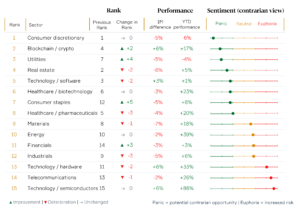
An interesting shift is emerging in October: While capital continues to flow into the big winners in the artificial intelligence and semiconductor sectors, defensive stock sectors are gaining relative strength.
In particular, consumer staples and utilities—which have received relatively little attention so far this year—are moving to the forefront in the Sector Radar.
This development is interesting from the perspective of the Hawk-Eye approach. When investors are skeptical about a sector but stock prices nevertheless outperform what sentiment would suggest, this may signal the beginning of a shift. When expectations are low, even minor positive surprises can be enough to trigger a stronger price reaction.
Three Notable Events in October
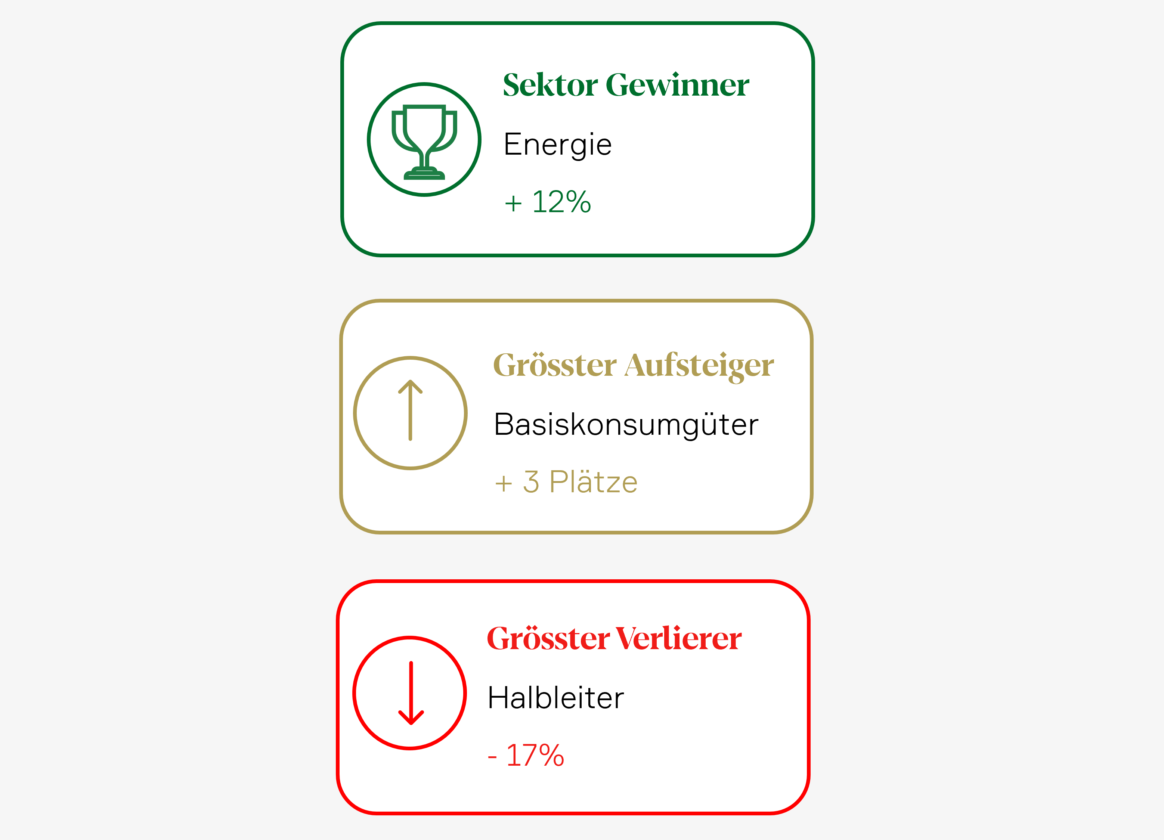
Biggest Winner: The energy sector posted the strongest performance in October, up 12%. Renewed attacks on energy infrastructure and shipping in the Middle East drove up oil prices and provided a tailwind for energy stocks.
Biggest Climber: The Consumer Staples sector climbs three places to rank 4 in the latest Hawk-Eye Sector Radar. Particularly interesting is the combination of negative investor sentiment and increasing relative strength. Despite subdued expectations, the sector is showing comparatively positive performance.
Biggest Loser: The semiconductor sector posted a 17% decline in October . Since the beginning of the year, however, it is still up 59 %. Despite this strong year-to-date performance, the sector has ranked last on the Hawk-Eye Sector Radar since June. From the perspective of our models, the euphoric investor sentiment and the correspondingly high expectations make it less attractive.
What does the “Radar” sector mean for the Tareno Hawk-Eye certificate?
The Tareno Hawk-Eye Sector Radar is not a standalone allocation model. Therefore, a sector’s high or low ranking does not constitute a direct buy or sell signal.
Rather, the Radar serves as an additional analytical component within the Tareno Hawk-Eye approach. It helps identify one-sided expectations and potential changes in market behavior at an early stage.
The actual investment decision continues to be made at the company level. What matters is not simply whether a piece of news is positive or negative, but above all how the market reacts to it.
After all, attractive investment opportunities do not necessarily arise where the outlook appears to be the best. What matters much more is what expectations are already priced into stock prices and where actual performance begins to diverge from those expectations.
Subscribe to the Monthly Fact Sheet
Sign up for our newsletter and receive the latest fact sheet on the Tareno Hawk-Eye Certificate directly by email every month. You’ll also receive the portfolio manager’s analysis and market commentary on the strategy’s performance.
Hawk-Eye certificate
Learn more about the Tareno Hawk-Eye Certificate.
Tareno Fund
Discover more funds from Tareno.
Disclaimer
This document has been prepared for marketing and informational purposes and does not constitute an offer or a solicitation to subscribe to, buy, or sell shares of this investment fund. It does not constitute investment advice. Only the current fund documents (in particular, the prospectus and KID) are exclusively authoritative. Past performance is not a reliable indicator of future results.
Images: Marijke Vosmeer, Luzia Hunziker, Jürg Kaufmann, Istock, Unsplash / Graphics: Tareno AG / Bloomberg