Dividend Stocks in Switzerland: What Investors Should Look for When Choosing Them
Are dividend stocks in Switzerland still attractive despite higher interest rates?
Dividend-paying stocks remain attractive in Switzerland even in the current interest rate environment, especially for investors seeking regular income and some protection against inflation. Thanks to Switzerland’s traditionally stable economy and the strong balance sheets of many companies, they continue to offer solid returns that compare favorably on an international scale.
The true added value of a dividend portfolio comes from:
- the quality of the companies
- the long-term reinvestment of earnings (compound interest effect)
Companies with a stable dividend policy are also subject to a certain degree of capital discipline, which can help prevent undesirable developments.
Other benefits include:
- Often more resilient price performance during periods of market volatility
- Predictable Income for Investors
- An Attractive Alternative During Periods of Low Interest Rates

What risks should investors be aware of when investing in dividend-paying stocks?
Investors should deliberately avoid exceptionally high dividend yields, as they often serve as a warning sign of potential cuts. It is also important to ensure that the dividend payout ratio relative to earnings is not overly generous. What matters most, therefore, is not the amount but the reliability—and thus the sustainability—of the dividend. Consequently, only companies with a stable and consistent dividend policy should be considered.
For a successful dividend portfolio, companies in sectors that have stable cash flows, high earnings visibility, and limited capital requirements are particularly attractive. Typical sectors include healthcare, telecommunications, insurance, utilities, consumer staples, and infrastructure. Less suitable are sectors with highly volatile earnings, high investment requirements, or a low willingness to pay dividends. These include sectors such as technology and cyclical industries.

How are dividends taxed in Switzerland?
In Switzerland, dividends are subject to ordinary income tax as investment income. In addition, a 35% withholding tax is deducted directly from the gross income at the federal level; however, this tax can be fully reclaimed if correctly reported on the tax return.
Dividend Stocks or Dividend Funds? Which Is the Better Choice?
There is no one-size-fits-all answer, as the “better” choice depends primarily on your risk tolerance, investment horizon, and the amount of time you’re willing to devote to it. Investing in individual dividend stocks is suitable for experienced and larger investors who want to build a customized portfolio, have sufficient time to devote to it, and possess in-depth market knowledge. Dividend funds (or ETFs) are ideal for straightforward, broadly diversified wealth accumulation, but they tend to have higher fees.
How do we at Tareno handle the dividend portfolio for our clients?
The Tareno dividend portfolio is guided by clear criteria:
In addition to offering an attractive dividend yield, companies must now pay out at least as much in dividends as they did five years ago. At the same time, the payout ratio must not be too high in order to ensure sustainability.
From this investment universe, the most promising securities are selected using financial analysis and proprietary valuation models. The goal is to achieve an optimal combination of quality and attractive valuation.
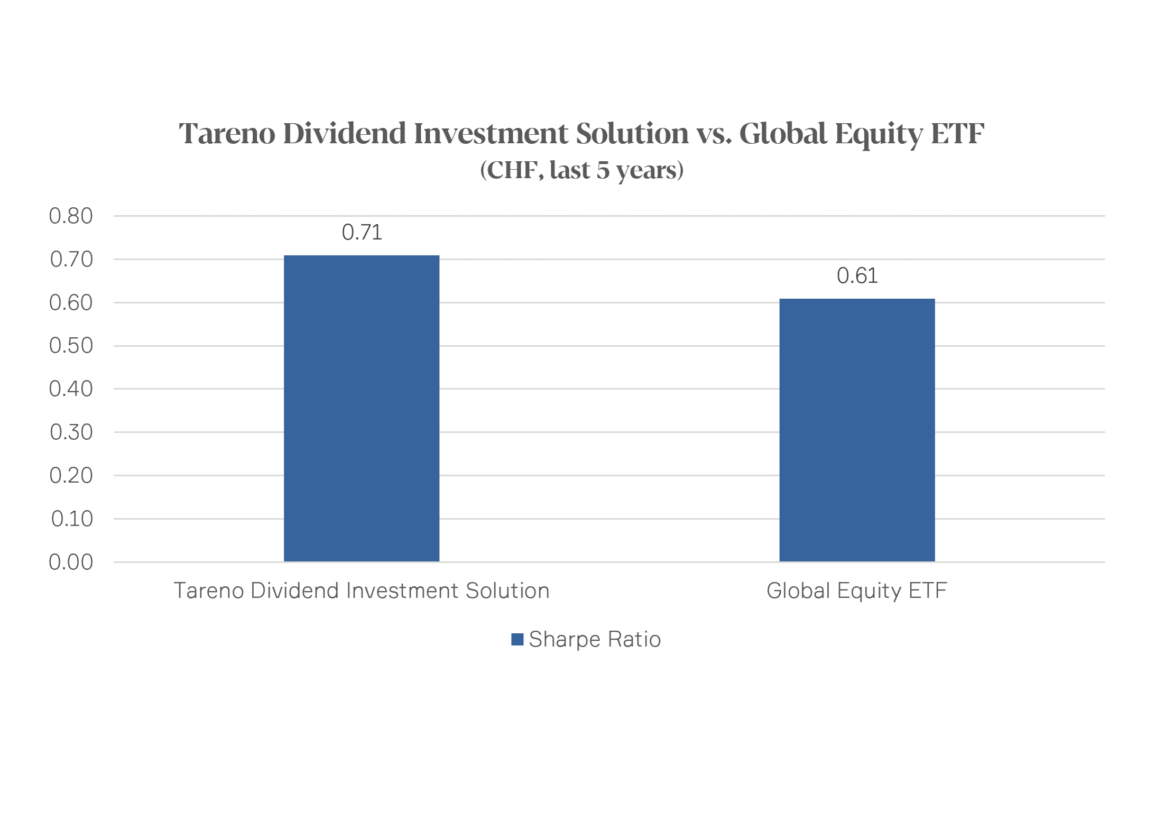
Dividend Strategy in Practice: A Better Sharpe Ratio
The Sharpe ratio is a financial metric used to measure the risk-adjusted return on an investment. It compares the excess return achieved above the risk-free rate to the volatility (risk) incurred. A higher value indicates a better risk-return ratio.
A look at the Tareno Equity Dividend Portfolio (80% global stocks, in CHF) over the past five years shows that it has achieved a Sharpe ratio higher than that of a global stock ETF. Dividend strategies are often underweight in the technology sector, as this sector tends to reinvest its earnings in future growth and is less interested in paying dividends. This makes it all the more remarkable that the Tareno dividend portfolio approach has proven its worth precisely during a period in which the technology sector has outperformed the market.
Which dividend stocks might investors want to take a closer look at right now?
Typical examples in a CHF dividend portfolio include Novartis, Swiss Life, and Swisscom. Not only do these companies offer high dividend yields, but—more importantly—they are able to reliably finance and increase their dividend payments over many years:
- Novartis is one of the world’s leading pharmaceutical companies and has a broad portfolio of innovative medicines for serious diseases. Demand for effective medicines is largely independent of economic fluctuations, which helps the company generate stable revenue. Thanks to high margins, robust research, and a solid balance sheet, Novartis consistently generates high free cash flow. This financial strength forms the foundation for an attractive dividend that has been rising for many years.
- Swiss Life benefits from the long-term trend of an aging population and the growing demand for retirement and financial solutions. The company derives an increasing share of its profits from recurring fee income, which is less susceptible to fluctuations than traditional insurance revenues. Disciplined capital allocation and strong capital position enable generous distributions to shareholders. In recent years, Swiss Life has continuously increased its dividend and also repurchased its own shares.
- As Switzerland’s leading telecommunications provider, Swisscom enjoys a strong market position and a loyal customer base. Mobile, internet, and TV subscriptions generate predictable and recurring revenue. The business is largely unaffected by economic cycles, as telecommunications is now considered an essential basic need. As a result, Swisscom generates stable cash flows even during difficult economic times and has been able to pay an attractive dividend for years.
Publisher: Tareno AG, Gartenstrasse 56, 4052 Basel, Tel. +41 61 282 28 00, info@tareno.ch, www.tareno.ch. We welcome feedback on our publication. This content is for information purposes only. The publication contains neither legal nor investment advice or investment recommendations and does not constitute an offer or solicitation to make an investment.
Images / Charts: The charts were created by Tareno AG using its own and publicly available market data.
Find out more about our expertise
Tareno AG
Your independent & excellent asset management
Tareno Dividend Investment Solution
Discover the Tareno Dividend Investment Solution