Healthcare Is More Than Just Pharma: Which Sub-Sectors Investors Should Know
Healthcare as an Investment Universe: More Than Just Medicines
In Switzerland in particular, healthcare as an investment theme is often equated with the pharmaceutical sector. This is understandable: With Roche and Novartis, two of the world’s largest pharmaceutical companies are practically on our doorstep and have been among the heavyweights of the Swiss stock market for decades.
However, the healthcare investment universe is much broader. According to the internationally recognized GICS classification, the sector comprises six subsectors: Pharmaceuticals, Biotechnology, Health Care Equipment & Supplies, Health Care Providers & Services, Life Sciences Tools & Services, and Health Care Technology.
In the MSCI World Health Care Index, the pharmaceutical and biotechnology sectors together account for about 64% of market capitalization. However, investors should not overlook the remaining 36%. This segment includes business models with risk, growth, and return characteristics that are, in some cases, significantly different and often complementary.
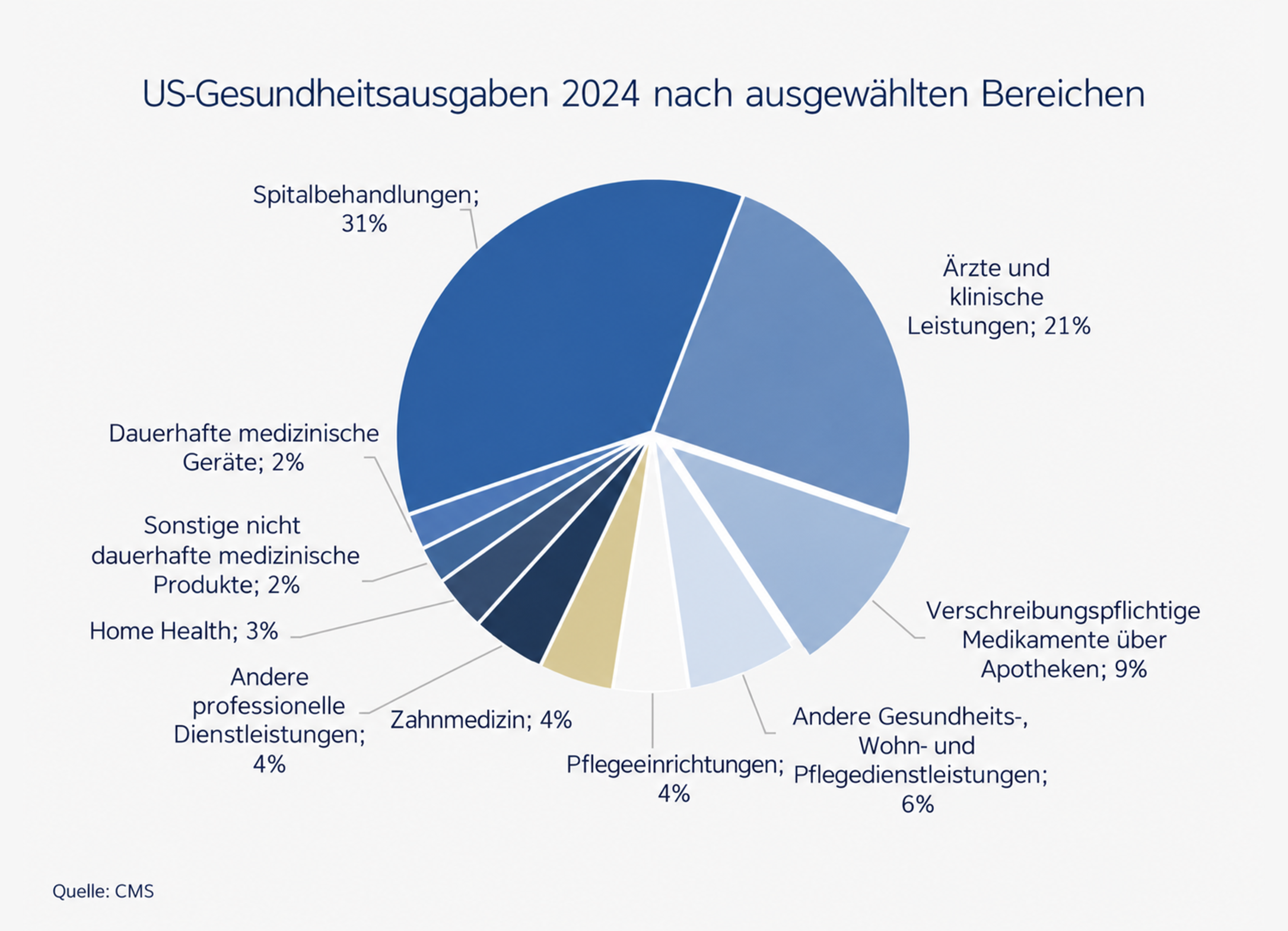
A look at healthcare spending reveals just how broad the sector really is
The Centers for Medicare & Medicaid Services (CMS), an agency of the U.S. Department of Health and Human Services, provides particularly detailed data on the healthcare market. In 2024, approximately $5.3 trillion was spent on health care in the U.S., accounting for about 18% of total economic output.
Of this total, only 9% was attributable to prescription medications dispensed through pharmacies. Significantly larger cost categories were hospital treatments at 31% and medical and clinical services at 21%. Other major categories included long-term care facilities, dental care, outpatient care, and medical devices.
Looking beyond the United States also reveals a long-term structural trend: As prosperity increases, per capita health care spending generally rises as well. In emerging economies in particular, the expansion of health care services is therefore likely to generate additional demand in the long term.
Healthcare extends far beyond the pharmaceutical industry
The pharmaceutical and biotechnology industries develop therapeutic agents. Traditionally, the term “pharmaceutical company” has primarily referred to companies whose drugs are based on chemically synthesized active ingredients. Biotechnology companies, on the other hand, develop therapies based on biological systems, such as cells, proteins, or genes.
However, this distinction is becoming increasingly blurred. Roche, for example, is now both one of the world’s largest pharmaceutical companies and one of the leading biotechnology companies.
Health Care Equipment & Supplies (MedTech) includes, among other things, implants, surgical instruments, diagnostic devices, diabetes technologies, and surgical robots. Swiss examples include Straumann, Sonova, and Alcon.
A defining feature of the medtech industry is that innovation often occurs incrementally: an implant or surgical system is continuously improved over many product generations. It is precisely this technical and mechanical nature of the products that creates ongoing opportunities for innovation. Our experience shows that not only groundbreaking developments but also the continuous refinement of existing medical technology is a key growth driver for the industry.
Health Care Providers & Services includes, among others, hospitals, nursing care providers, laboratory service providers, distributors, and health insurers. A Swiss example is Galenica, a pharmaceutical distributor and operator of pharmacies. Internationally, this segment also includes major health insurers and hospital groups.
Factors such as capacity utilization, personnel costs, compensation systems, and operational efficiency play a much greater role here than, for example, patents or clinical trials.
Life Sciences Tools & Services are largely suppliers to the biopharmaceutical industry. They provide instruments, consumables, and research and production services to pharmaceutical and biotechnology companies. In Switzerland, for example, Lonza, Bachem, and Tecan are part of this sector.
Healthcare technology encompasses software, data platforms, and IT services specifically designed for doctors, hospitals, and other healthcare companies. One internationally recognized example is Veeva Systems.
A distinctive feature of the healthcare sector remains the high degree of fragmentation and the sensitivity of medical data. It is precisely this that makes digitization both particularly attractive and challenging.
Same long-term drivers, but different business models
Almost all healthcare sectors benefit in the long term from several structural growth drivers:
- Population Aging: As people age, many health conditions become more prevalent, and with them, the need for medical treatment increases.
- Changing Lifestyles: Obesity, diabetes, and other chronic diseases are increasing the need for treatment worldwide.
- A growing middle class in emerging markets: As prosperity rises, access to medical care improves, as do people’s financial ability to seek health services.
- Digitalization and innovation: New medications, medical technologies, and digital solutions make it possible to treat diseases more effectively—or for the first time at all—and make existing therapies more efficient.
Despite these shared growth drivers, the investment characteristics of the individual subsectors differ significantly.
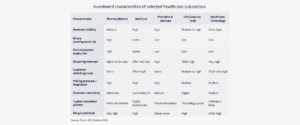
A successful drug, for example, can generate billions in revenue. At the same time, expiring patent protection, competing products, or disappointing clinical trial data can significantly impact the economic value of a pharmaceutical or biotech company—and thus its stock price as well.
In contrast, for a medtech company, growth is often spread across a wide range of products, product generations, and medical procedures. At the same time, a successfully established system can create long-term competitive advantages, such as through a large installed base, training, software, or recurring consumables.
Life sciences companies, in turn, are more heavily dependent on the research and investment budgets of their pharmaceutical and biotech clients. For hospitals and health insurers, on the other hand, factors such as personnel costs, capacity utilization, and regulatory reimbursement systems play a greater role.
Because of these differing business models and risk drivers, the individual healthcare subsectors can perform very differently on the stock market over the years.

What should investors look out for?
One of the most common mistakes is to view healthcare as a homogeneous investment theme. While a pharmaceutical company, a manufacturer of cardiac catheters, a health insurer, and a supplier of laboratory instruments all belong to the healthcare sector, their business models and financial characteristics differ significantly.
It is therefore worthwhile for investors to ask three specific questions about every company:
-
What factors influence growth?
-
How predictable are revenue and cash flow?
-
What events could fundamentally change the investment thesis?
For us, that is precisely the key point: Healthcare is too broad an investment universe to be reduced to just the pharmaceutical sector.
The pharmaceutical sector offers high margins and significant opportunities for innovation, but it also involves patent and development risks. MedTech companies can build attractive and highly predictable business models based on installed systems and recurring consumables. Life Sciences Tools enable participation in research and innovation without bearing the full clinical risk of a single drug. Providers & Services and Health Care Technology, in turn, contribute different revenue drivers and risk profiles to a portfolio.
Diversification within the healthcare sector therefore does not simply mean investing in multiple companies. Rather, the key is to combine different business models, growth drivers, and risks.
Conclusion: Take a nuanced approach to healthcare stocks
Healthcare is much more than just pharmaceuticals. The sector encompasses an exceptionally broad range of business models.
It is precisely this breadth that makes the healthcare sector particularly exciting, but it also requires in-depth expertise. Those who understand the various business models as well as their scientific, regulatory, and economic drivers can make informed assessments of opportunities and risks.
Learn more about Tareno’s expertise in the healthcare sector on our website.

Find out more about us.
Discover More Financial Guides
Expand your knowledge with our analyses and expert articles on wealth management and investing.
Learn About Tareno Funds
Learn more about our diverse range of equity funds and our many years of expertise in asset management.