Why a Clear Plan Is More Important Than Any Forecast
BMW: If the Market Doesn’t Confirm the Signal
The automotive industry is undergoing a profound structural transformation due to the transition to electric mobility. New competitors, particularly from China, are putting pressure on established manufacturers with rapid innovation and aggressive pricing.
This disruption also led to widespread skepticism about BMW in the market. While BMW was at times valued at double-digit P/E ratios in earlier market phases, its current P/E ratio stands at around 5.
Combined with the strongly negative sentiment, this created an interesting countercyclical starting point. For the Hawk-Eye approach, however, a favorable valuation alone is not enough. The key factor is whether the market begins to confirm this starting point through its price action.
From Entry to Exit
At BMW, the investment process followed four clear steps:
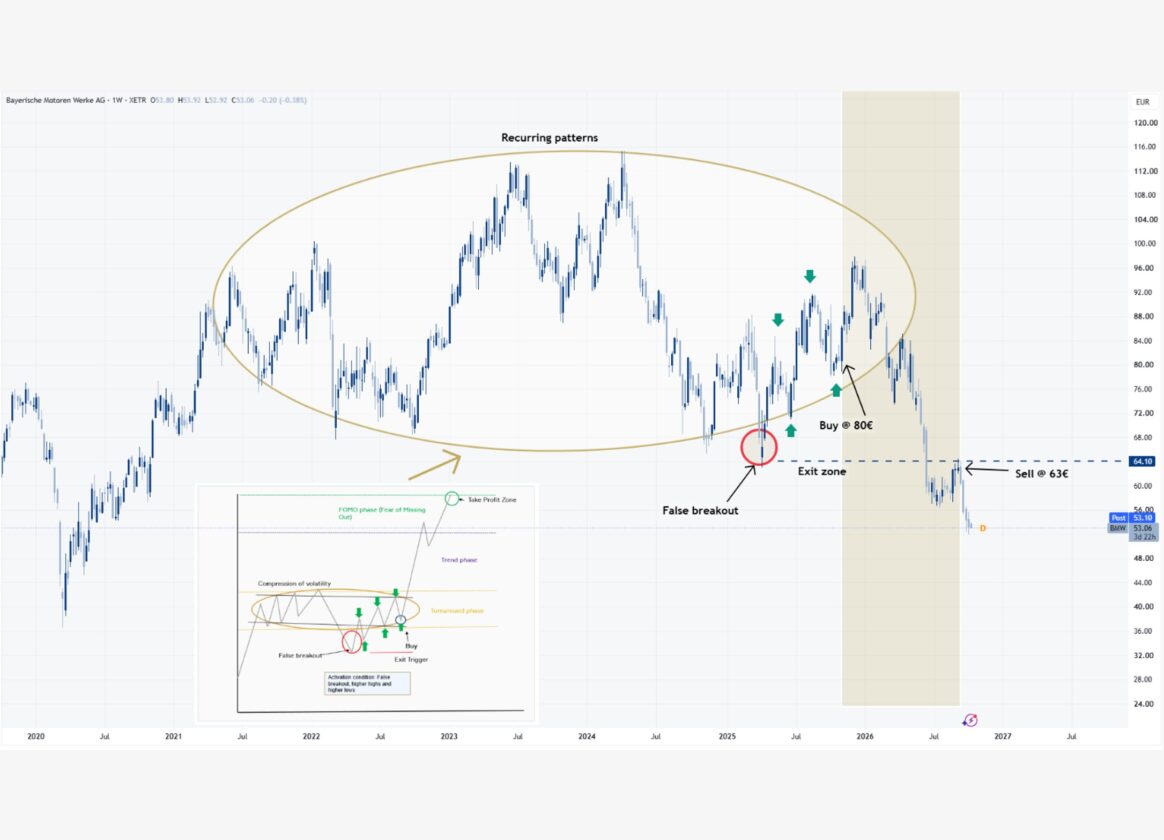
1. Waiting for the turnaround
A low valuation is not necessarily a buy signal. Especially during a period of structural upheaval, historical valuation benchmarks can shift. As long as a stock continues to hit new lows, our models therefore wait for clearly defined reversal patterns in its price movement.
2. Recognizing the entry signal
At BMW, a distinctly negative sentiment coincided with an increasingly constructive price pattern and rising relative strength. When the market thus confirmed our contrarian position, we built a position.
3. There has been no confirmation from the market
However, the expected continuation did not materialize. The relative strength disappeared, and the positive price pattern was negated. As a result, a key component of the original investment case was no longer present.
4. A Consistent Phase-Out
We sold the position in accordance with our rules. Not because BMW had suddenly become fundamentally unattractive, but because the market no longer confirmed our original signal.
Limit losses, protect capital
Not every signal works. Therefore, what matters is not being right about every assessment, but knowing right from the start when you’re wrong.
Clear exit rules help limit losses, avoid deadweight positions in your portfolio, and keep capital available for new opportunities. This is precisely where a key advantage of the Tareno Hawk-Eye approach lies: The strategy does not follow an opinion about the market, but rather a disciplined process with clear rules for entry and exit.
Subscribe to the Monthly Fact Sheet
Sign up for our newsletter and receive the latest fact sheet on the Tareno Hawk-Eye Certificate directly by email every month. You’ll also receive the portfolio manager’s analysis and market commentary on the strategy’s performance.
Hawk-Eye certificate
Find out more about our Hawk-Eye certificate.
Tareno Fund
Discover more funds from Tareno.
Disclaimer
This document has been prepared for marketing and informational purposes and does not constitute an offer or a solicitation to subscribe to, buy, or sell shares of this investment fund. It does not constitute investment advice. Only the current fund documents (in particular, the prospectus and KID) are exclusively authoritative. Past performance is not a reliable indicator of future results.
Images: Marijke Vosmeer, Luzia Hunziker, Jürg Kaufmann, Istock, Unsplash / Graphics: Tareno AG / Bloomberg