When Quarterly Earnings Move the Market
The market reacts in seconds
The immediate stock market reaction was extraordinary: Amazon rose about 15% following the earnings report, and Microsoft rose about 16%. For Microsoft, this represented an increase in market value of approximately $450 billion in a single trading day. This illustrates just how sensitive the stock prices of large technology companies are to even relatively small deviations from market expectations.
Two Strong Results, One Common Driver
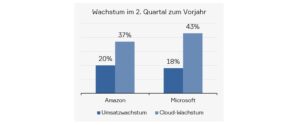
Amazon increased revenue by 20% to $200.6 billion in the second quarter and operating profit by 43%. The main driver was Amazon Web Services. AWS grew by about 37% and achieved an operating margin of 39.4%. The advertising business also performed very strongly, with growth of 26%.
Microsoft increased its quarterly revenue by 18% to $90.0 billion and its net income by 31%. The Azure cloud platform grew by 43% and exceeded the $100 billion revenue mark for the first time in a full fiscal year. Furthermore, more than 30 million paid Copilot licenses demonstrate that monetizing artificial intelligence is increasingly becoming part of the core business, even though it currently accounts for only a fraction of Microsoft’s total revenue.
Heavy Investment: A Burden Now, but a Prerequisite for Growth
Both companies are investing on an extraordinary scale. Amazon raised its 2026 capital expenditure forecast to $220 billion, while Microsoft expects approximately $175 billion. The majority of these funds are going toward data centers, chips, networks, and other AI infrastructure.
In the short term, this puts pressure on free cash flow. At Amazon, free cash flow turned negative on a 12-month basis, even though operating cash flow rose sharply. Microsoft reports significant future obligations under data center contracts.
What matters here is not just the amount of the investment, but whether it generates sustained additional revenue and attractive returns on investment.
Quarterly Results Are a Snapshot
At Amazon, AWS growth accelerated for the fifth consecutive time. At Microsoft, the cloud and AI businesses performed significantly better than the weaker PC and Xbox segments. Even though this represents a positive trend for both companies, a quarterly report remains a snapshot.
The long-term investment thesis remains intact
Three questions are central to our assessment: Will demand remain structurally high? Can the companies defend their leading market positions? And do future cash flows justify current valuations and investments?
We believe that Amazon and Microsoft continue to meet these criteria in principle. The strong order backlog, accelerating cloud demand, and growing use of AI applications support the positive fundamental assessment. At the same time, the coming quarters will show how efficiently the enormous investments are being converted into additional revenue and free cash flow.
Don’t Chase Every Price Spike
A positive long-term outlook does not mean extrapolating every short-term price movement. After double-digit daily gains, the risk increases that investors will pay twice for good news regarding an already high valuation and rising expectations. Conversely, it would be just as wrong to prematurely abandon a sound investment thesis based on a single disappointing forecast.
Implications for the Portfolios
This leads to a disciplined middle ground in portfolio management. We remain committed to high-quality companies with sustainable competitive advantages, but we continuously review position sizes and valuations. Precisely because Amazon and Microsoft have large index weights and are key portfolio holdings in the Classic strategies, their fundamental strength must be balanced with deliberate concentration management.
Conclusion
Amazon and Microsoft have had a noticeable short-term impact on the stock market. However, this price spike is not the most important signal for our investment decisions. What matters most is that the long-term drivers have been confirmed: accelerated cloud growth, increasing AI monetization, strong market positions, and high demand for digital infrastructure.
We therefore remain positive about both companies over the long term. At the same time, we view each quarterly report as a new data point rather than a definitive judgment. This perspective helps us put short-term market movements into context and consistently align portfolios with long-term earnings potential rather than the next headline.
Contact: Andreas Borer, Senior Portfolio Manager, a.borer@tareno.ch
Publisher: Tareno AG, Gartenstrasse 56, 4052 Basel, Tel. +41 61 282 28 00, info@tareno.ch, www.tareno.ch. We welcome feedback on our publication. The content herein is provided for informational purposes only. This publication does not contain legal or investment advice or investment recommendations, nor does it constitute an offer or a solicitation to make an investment. Images / Charts: The charts were prepared by Tareno AG using publicly available market data.
Do you have any questions on this topic?
Our portfolio management team will be happy to provide you with explanations and clarifications.
Find out more about us
Asset management
Publications