Brunetti View: The Remarkably Strong Swiss Economy

After a long slump, the industry is regaining momentum
The industrial sector, in particular, appears to be gaining some momentum over the course of the year after a very long slump. Consequently, slightly higher growth is generally expected for 2027. The biggest macroeconomic concern at the moment, in my view, is the trend in inflation—not in Switzerland, but among its key trading partners. Although the post-pandemic surge in inflation was contained through a monetary policy response that was too late but ultimately decisive, However, neither the U.S. nor the eurozone has subsequently managed to bring core inflation (inflation excluding volatile energy and food prices) below the ominous 2% threshold. This signals that inflationary trends remain outside the realm of price stability.

The recent rise in oil prices, in particular, has now led to significantly higher inflation. And because efforts to lower core inflation have not really succeeded, this rise is occurring against a backdrop of heightened inflation expectations, which favors the emergence of wage-price spirals and, consequently, sustained inflationary momentum. If the ECB and, above all, the Fed want to break this momentum, they would have to respond quickly with several interest rate hikes. Given the U.S. president’s expectations for his newly appointed Fed Chair, Kevin Warsh, this is likely to be extremely difficult, particularly across the Atlantic. A rapid decline in inflationary momentum, especially in the U.S., is therefore not expected in the near future. Given the significant inflation differentials, this is likely to contribute to a further nominal strengthening of the Swiss franc in the coming months—unless the SNB takes strong countermeasures—without affecting the price competitiveness of the Swiss economy (unchanged real exchange rate).

Have the Swiss really become richer in recent years?
However, I would like to focus on another, more encouraging aspect as the main topic of this “View.” Specifically, it concerns a question that has been raised time and again in the heated debate over the 10-million initiative and that will certainly shape the upcoming debate on EU policy as well. Have the Swiss really become wealthier in recent years, or have we merely experienced so-called “broad-based” growth that leaves per capita income unchanged? SECO recently published insightful data that allows us to explore this question in greater depth.
A clear lead in prosperity…
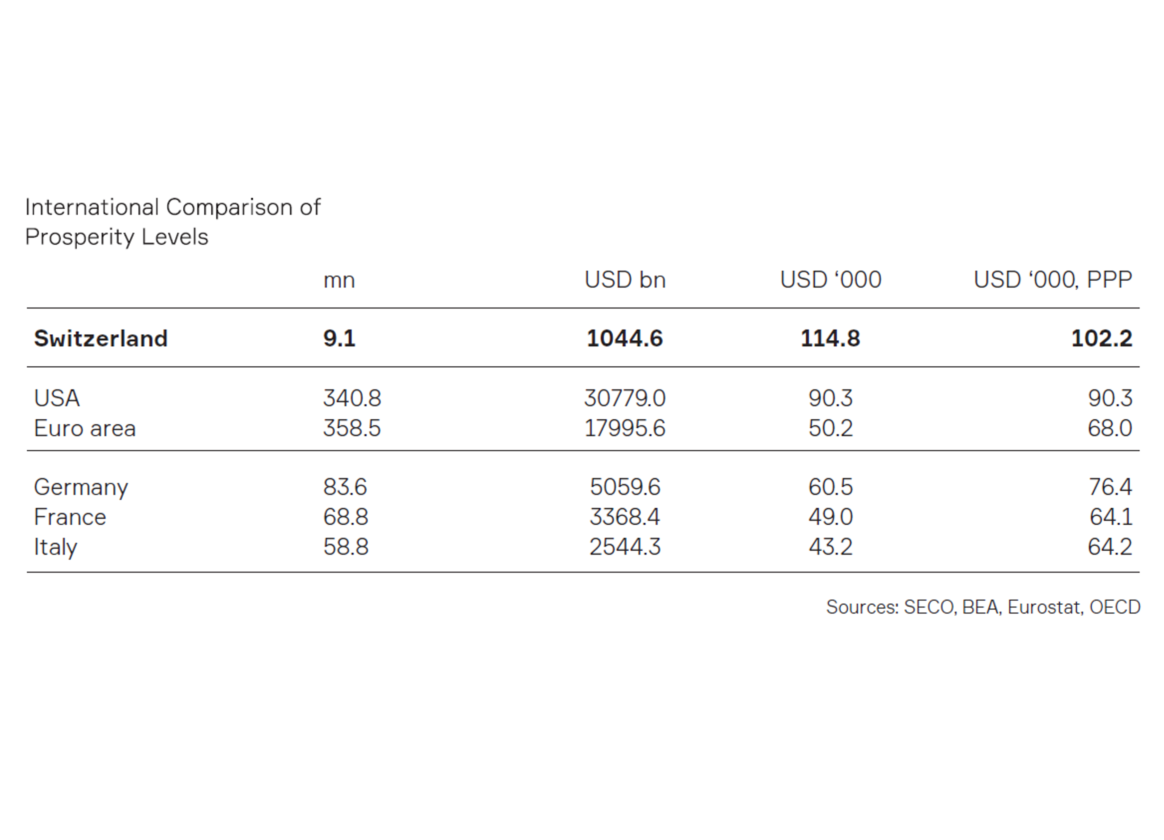
How wealthy are we today compared to other major industrialized nations? To answer that question, we need to go through the table below—taken from the SECO publication—step by step. Here, Switzerland is compared for the year 2025 with the United States, the entire eurozone, and the three largest countries in the eurozone. Most people would probably assume—before consulting this table—that Switzerland is somewhat wealthier than the eurozone countries, but less wealthy than the United States, which has been highly praised in recent decades. The first column of the table shows the population of these countries, and the second column shows their gross domestic product (GDP) converted into dollars at current exchange rates. Dividing GDP by the population yields the GDP per capita in thousands of U.S. dollars in the third column; this is the key metric typically used to compare prosperity among industrialized nations. The results speak for themselves. Based on this indicator, Switzerland is more than twice as wealthy as France or Italy, and even Germany lags far behind.
… and continued dynamic growth
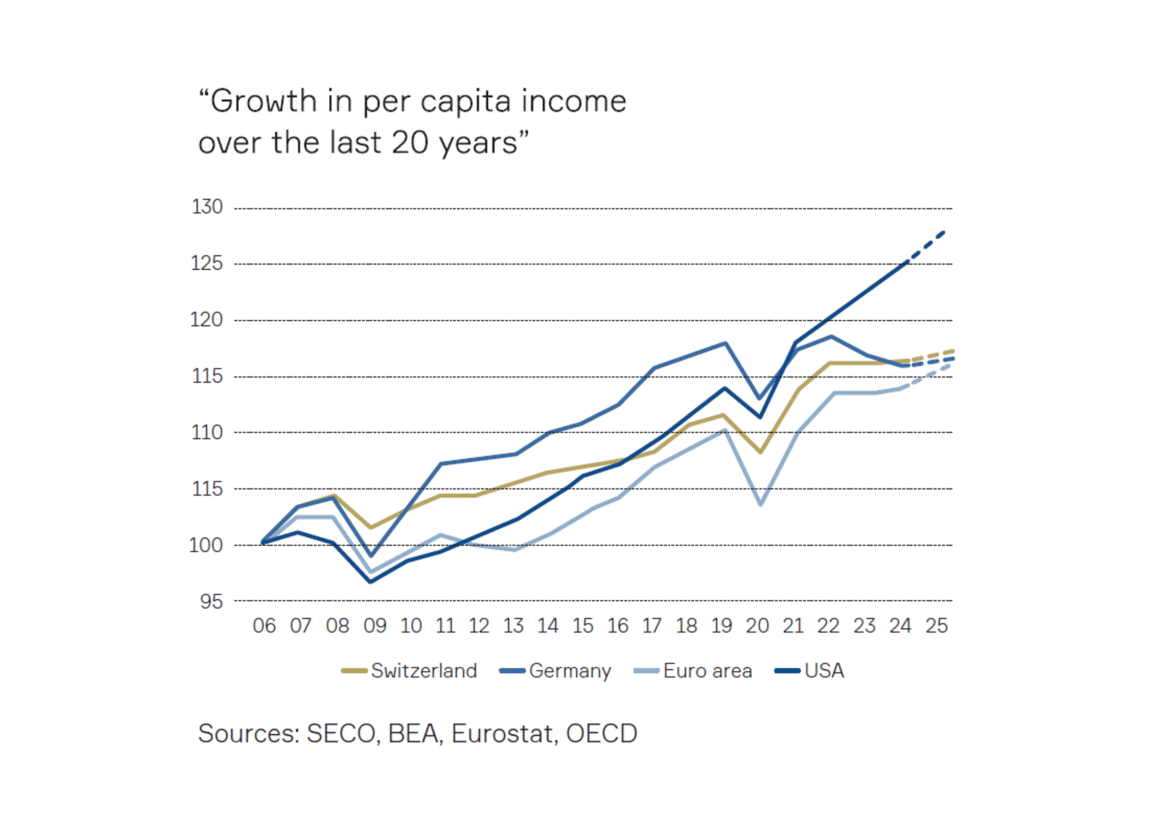
With the chart titled “Growth in Per Capita Income Over the Last 20 Years,” we will now turn our attention to growth trends.
It shows the trend in per capita income for a similar group of countries, using an index with 2006 as the base year. It can be seen that Switzerland experienced growth similar to that of Germany or the eurozone as a whole, and slightly lower than that of the United States. The graph clearly contradicts the theory of purely “broad-based growth,” since the curve would have to be flat in that case. Combining this with the analysis in the previous table makes it clear just how remarkable Switzerland’s performance was. Switzerland was already by far the richest of the countries under consideration at the outset and has continued to grow at the same strong rate from that leading position. Economic theory and most empirical findings generally predict convergence, meaning that rich, comparable countries should actually have lower growth rates than poorer ones. Switzerland is so successful that its performance over the past 20 years contradicts this economic rule. Incidentally, the more dynamic growth of the U.S. during this period must be viewed in context, as the irresponsibly rising national debt suggests that excessively inflated government demand may have fueled an unsustainable boom there.

The combination of excellent economic conditions, sound economic policy, and internationally successful companies across a wide range of industries has ensured that Switzerland has enjoyed great economic success during the turbulent past few decades. There are few reasons to question the core elements of this economic model.
Find out more about our expertise
Investment advice
Are you looking for an asset management firm that takes responsibility while also fostering personal interaction on an equal footing? At Tareno, our investment advisory services combine professional expertise with personalized support.
Advisory Board: Prof. Dr. Aymo Brunetti
Our advisory board member, Prof. Dr. Aymo Brunetti, regularly briefs our client advisors and our investment committee on important macroeconomic developments. His assessments are incorporated into Tareno’s investment policy and thus make a valuable contribution to our investment decisions.
Responsible
Simon Lutz
Chief Investment Officer
s.lutz@tareno.ch
Disclaimer
The statements and information in this publication have been compiled by Tareno AG to the best of its knowledge, in part from external (publicly accessible) sources which Tareno AG considers to be reliable, for information purposes only. This publication is not the result of a financial analysis. Tareno AG and its employees are not liable for incorrect or incomplete information or for losses or lost profits resulting from the use of information and the consideration of opinions expressed. The statements and information do not constitute a solicitation or invitation, offer or recommendation to buy or sell any investment instruments or to engage in any other transactions.
Nor do they constitute a specific investment proposal or other advice on legal, tax or other issues. A positive return on an investment in the past is no guarantee of a positive return in the future. The statements, information and opinions expressed herein are current only as of the date of this document and are subject to change at any time.
Duplication or reproduction of this publication, even in part, is not permitted without the written consent of Tareno AG. The “Guidelines to ensure the independence of financial analysis” of the Swiss Bankers Association do not apply. [Images: IStock, Shutterstock, Pixabay, Unsplash. Originals: Marijke Vosmeer, Charts: Tareno AG]