Investments in Infrastructure Facilities
Private Market Investments: A New Approach to Wealth Management
After years of exceptionally low interest rates and in light of persistent inflation risks, investors face a challenge: Bonds, which traditionally make up a significant portion of portfolios, barely generate enough returns to ensure capital preservation when inflation, taxes, and costs are taken into account—especially in Switzerland. Not least for this reason, we have decided to take a cautious first step toward private market investments.
What are private market investments?
Unlike publicly traded stocks and bonds, private market investments are investments in unlisted stocks and bonds. For example, with SpaceX’s recent initial public offering (IPO), a private market investment became a publicly traded stock.
The lines between listed and unlisted investments are becoming increasingly blurred. While private markets were once considered illiquid, difficult to access, and lacking in transparency, new fund structures, a maturing secondary market, and improved data availability are now increasingly opening up access to these markets for individual investors as well.
Infrastructure: Stability in Uncertain Times
Private markets include, among other things, infrastructure investments. Private infrastructure encompasses investments in critical infrastructure such as transportation networks, energy generation, and communications networks. Since these assets form the foundation of the economy and society, they offer particular advantages: stable cash flows from long-term contracts, natural protection against inflation through price-indexed returns, lower volatility than stocks due to their lower sensitivity to economic cycles, and significantly higher returns than bonds. In addition, infrastructure investments exhibit low correlation with stocks and bonds, making them particularly attractive as a portfolio complement.
Long-Term Growth Potential
According to the 2017 Global Infrastructure Outlook, the need for infrastructure investment is expected to double between 2015 and 2040. At the time of publication, Oxford Economics calculated a total funding gap of USD 15 trillion compared to existing financing plans. In the meantime, driven by two megatrends, that estimate is likely to be even higher: Digitalization is driving demand for data centers, 5G networks, and fiber-optic infrastructure. The energy transition requires massive investments in renewable energy, power grids, and sustainable technologies.
How to Invest?
In recent years, various providers of private market investments have launched fund solutions for retail investors. These typically offer monthly valuations as well as limited quarterly redemption options.
A specialized asset management mandate, such as the one offered by Tareno, simplifies access to such investments and often makes it more cost-effective. This is due to the pooling of investment capital, access to institutional share classes, better negotiating terms, and the professional selection and ongoing monitoring of the funds.
Since our first private market investment five years ago, we have expanded our portfolio to include four private market funds, two of which focus on infrastructure. Our most recent addition is the Blackstone Infrastructure Strategies ELTIF.
We chose this second infrastructure fund because Blackstone is one of the world’s leading infrastructure investors and has a long-standing, impressive track record. As one of the largest players in this sector, Blackstone has access to attractive transactions and extensive experience in implementing and developing complex infrastructure projects.
The fund is diversified across the sectors of digital infrastructure, energy, and transportation. This focus enables targeted exposure to structural growth themes such as digitalization and the energy transition.
After the first three months, our clients can look forward to a net return of 13% in EUR, which is well above the annual target return of 10%.
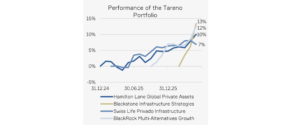
Our selection of private market funds now complements our portfolios with an allocation of up to 13% in selected investment solutions, thereby significantly enhancing the stability, diversification, and long-term return potential of our client portfolios.
You can find more information about our investment solutions here:

Find out more about us
Tareno Asset Management Mandate
Publications
Publisher: Tareno AG, Gartenstrasse 56, 4052 Basel, Tel. +41 61 282 28 00, info@tareno.ch, www.tareno.ch. We welcome feedback on our publication. This content is for information purposes only. The publication contains neither legal nor investment advice or investment recommendations and does not constitute an offer or solicitation to make an investment. The chart was created for this post using publicly available market data. Marketing communications.