When Pessimism Meets Relative Strength
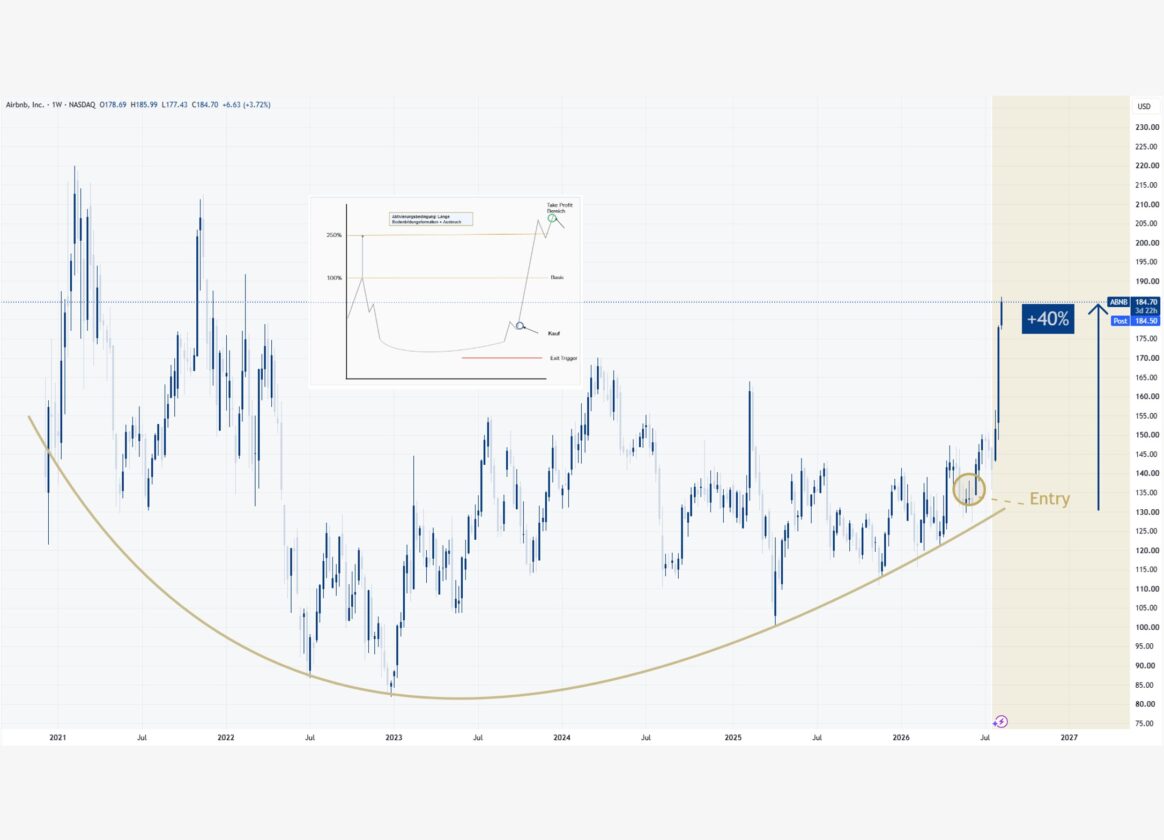
Relative Strength as a Key Indicator
According to the latest Bank of America Fund Manager Survey, the cyclical consumer sector remains among the least popular market segments. For the Hawk-Eye approach, however, such an environment is not automatically negative. What matters is not just how popular or unpopular a sector is, but how individual stocks react to this environment.
For us, therefore, extreme sentiment is not a buy signal. It only becomes interesting when a stock shows relative strength despite a weak sector environment and forms a constructive price pattern. This is precisely where a key strength of the Hawk-Eye approach lies: It does not look for the supposed bottom, but waits for confirmed changes.

Three Signals Supporting the Investment Case for
Three factors recently converged at Airbnb that supported the positive outlook indicated by our models:
Extreme Sentiment:
The cyclical consumer sector remained significantly unpopular among global fund managers. For Tareno Hawk-Eye, such sentiment is an important context but not yet a standalone entry signal.
Constructive price pattern:
While the sector remained under pressure, Airbnb developed increasing relative strength. The clearly defined price pattern provided our models with the entry signal.
Confirmation through the market reaction:
The subsequent quarterly earnings led to a disproportionately strong price reaction. Airbnb thus once again clearly distinguished itself from the cyclical consumer sector and confirmed the previously identified signal.
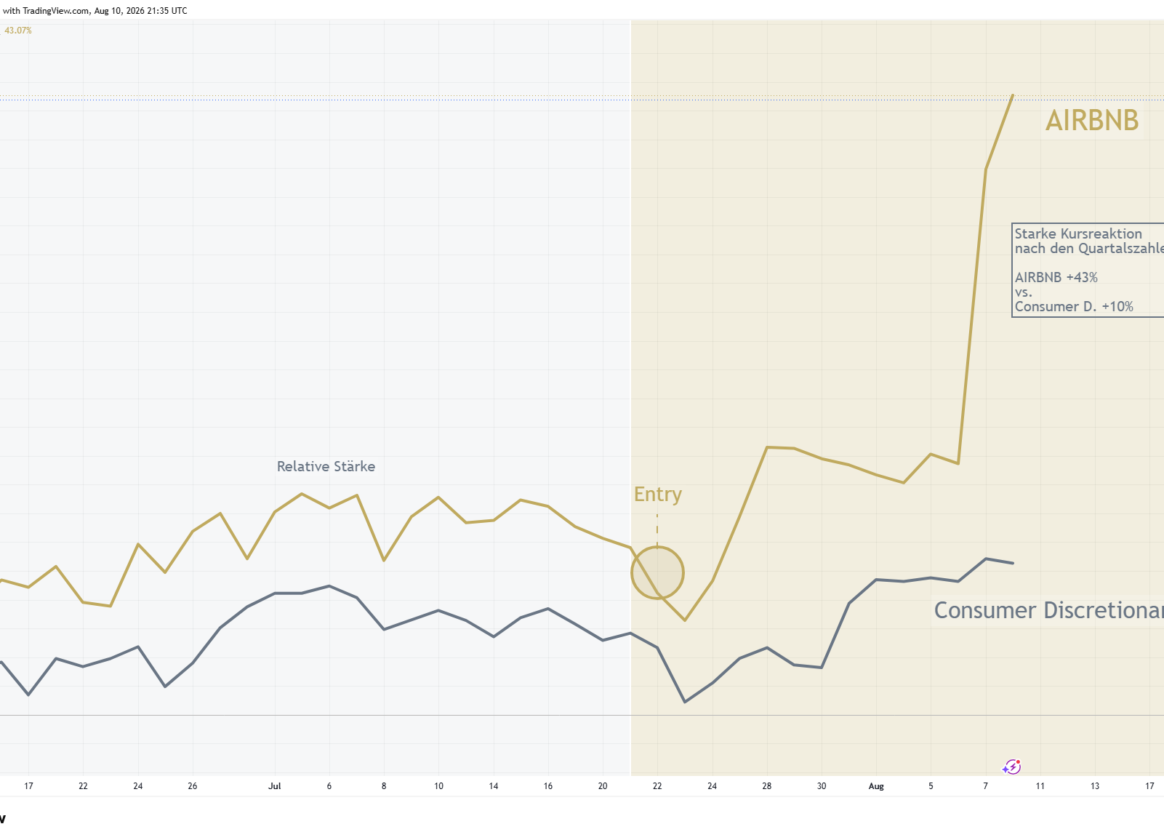
Airbnb Impresses with a +22% Gain in Two Days
Airbnb is a prime example of how the Hawk-Eye approach works in practice. Even before the quarterly earnings were released, our models identified increasing relative strength. At the same time, the stock developed a positive price pattern despite the weak sector environment.
Following the release of its quarterly earnings, Airbnb’s stock rose by approximately +22% within two trading days (as of August 10, 2026). The strong market reaction confirmed the signal we had previously identified. From a fundamental perspective, the company also impressed with strong growth, a solid balance sheet, and an attractive risk-reward ratio.
Consistently capitalizing on confirmed market changes
Airbnb thus illustrates a core principle of the Tareno Hawk-Eye approach: It is not the news itself that matters, but the market’s reaction to it. Our investment process does not attempt to predict turning points. It waits for confirmed changes and systematically acts on them.
Every day, our quantitative models scan several thousand stocks worldwide for precisely these kinds of patterns. The goal is to identify recurring market behaviors early on, evaluate them objectively, and consistently implement them in the portfolio.

Would you like to find out more?
Do you have any questions about the Chart of the Month or would you like to find out more about our Hawk-Eye strategy? Our fund manager, Manuel Schmedler, looks forward to hearing from you.
Hawk-Eye certificate
Find out more about our Hawk-Eye certificate.
Tareno Fund
Discover more funds from Tareno.
Disclaimer
This document has been prepared for marketing and informational purposes and does not constitute an offer or a solicitation to subscribe to, buy, or sell shares of this investment fund. It does not constitute investment advice. Only the current fund documents (in particular, the prospectus and KID) are exclusively authoritative. Past performance is not a reliable indicator of future results.
Images: Marijke Vosmeer, Luzia Hunziker, Jürg Kaufmann, Istock, Unsplash / Graphics: Tareno AG / Bloomberg