Tareno View July 2026
Published: July 10, 2026
AI in the Portfolio: Seizing Opportunities, Managing Risks
Artificial intelligence has long been more than just a technological topic. It has become one of the most important drivers of growth in the global economy and a dominant factor in the financial markets. But the greater its influence becomes, the more important it is to manage the associated portfolio risks. For investors, this is a balancing act: Those who do not invest are missing out on a rare structural opportunity. Those who blindly follow the index are accepting growing concentration risks. The AI component of a portfolio is increasingly becoming a central issue in strategic asset allocation. That is why, in this Tareno View, we take a close look at the impact of AI on the economy and markets, as well as the right positioning within a portfolio.
Macroeconomic environment
A Shock-Resilient Economy
In recent years, the global economy has weathered more shocks than many economic models thought it could handle: supply chain disruptions, the war in Ukraine, a surge in inflation, record-high interest rates, banking stress, China’s real estate crisis, U.S. tariffs, and energy price shocks. Nevertheless, the global economy has been growing at a rate of about 3% per year since 2022.
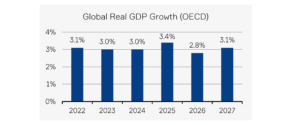
Even the most recent energy price shock surrounding the Strait of Hormuz failed to derail the global economy. Although the situation remains fragile, the price of oil has fallen significantly again. Strategic reserves, alternative supply routes, increased production outside the directly affected region, and lower energy intensity are keeping the impact in check.
Where does this remarkable resilience come from? From our perspective, there are two structural tailwinds at play—ones we have been emphasizing for some time—that have given us the confidence to remain invested within our respective risk profiles during market pullbacks.
First, the government remains a powerful pillar of economic growth. The U.S., China, and Europe are supporting their economies—amid competition among the major blocs—through investment programs, tax breaks, industrial policy, and defense spending. In the U.S., fiscal policy has recently accounted for nearly half of the contribution to growth. This is not a clean foundation, but it is an effective one.
Second, the multi-year expansion of AI is fueling an investment cycle of historic proportions. The rising demand for AI applications is leading to extensive investments in data centers, semiconductors, power grids, and software. As a result, AI has long been a driver of the real economy, making a tangible contribution to economic growth.
Fiscal policy and AI, the pillars of growth, will remain intact for the foreseeable future and thus continue to provide a solid foundation for global growth. At the same time, two headwinds from recent months are subsiding: the oil price shock and the impact of U.S. tariffs. This improves the outlook for consumers and businesses in the second half of the year.
Market commentary
AI dominates
The two drivers of growth in the real economy—government spending and AI expansion—are increasingly shaping the financial markets as well. In the past quarter, the AI sector was once again responsible for a large portion of global stock market gains.
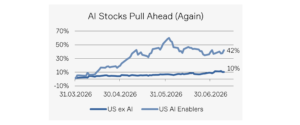
Since AI-related companies have significantly outperformed the broader market in recent years, their share of the total market has risen from about a quarter to nearly half. This trend is particularly pronounced in the semiconductor and hardware sectors. The semiconductor segment alone now accounts for about 15% of the global index. This has significant implications for investors.
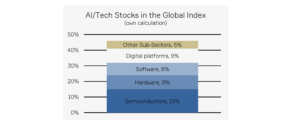
First, concentration risk is rising. Many index-tracking portfolios today are more dependent on AI, technology, and the U.S. than it appears at first glance. What is marketed as broad global diversification often contains a concentrated bet on just a few business models. Second, volatility is increasing. When capital flows in semiconductors and AI infrastructure shift, it’s not just a basket of sectors that moves—it’s the entire market. This makes the market more vulnerable to valuation debates, earnings disappointments, and delays in realizing AI’s productivity potential.
Market Leadership in a Time of Change
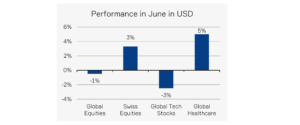
A countertrend began in early June. Capital has flowed out of the most obvious winners of the AI infrastructure expansion into other market sectors, and the technology sector—particularly the overheated semiconductor industry—has entered a consolidation phase. At the same time, healthcare, industrials, financials, and consumer staples have gained relative strength. We see a good chance that this broader market trend will continue.
Future developments will depend heavily on adjustments to earnings expectations. Growth in the technology sector is likely to remain strong, but the base effect will pose a greater challenge. In the rest of the market, however, earnings are expected to regain momentum.
This also puts the Swiss stock market back in the spotlight. The SMI—which includes Nestlé, Novartis, and Roche—has recently benefited from a return to defensive, high-quality stocks and was among the strongest-performing indices in June.
Investment policy
Dosing AI
Artificial intelligence will profoundly transform the economy and society. The multi-year expansion of AI infrastructure represents an investment opportunity of the kind that arises only once every few decades. We want to remain part of this trend. At the same time, with every further rise in prices, this sector’s influence on the overall market grows. Therefore, the key question is not whether AI belongs in a portfolio. The key question is how much AI a portfolio should contain.
Step 1: Assess Risks
How much AI is in the portfolio? This question is more difficult than it sounds. AI is not a clearly defined sector. Semiconductors, hardware, software, the cloud, digital platforms, and power infrastructure are all part of the value chain. According to a broad definition and our own calculations, AI and technology-related stocks in the MSCI ACWI now account for about 46% of the stock market. In our Classic portfolios, this weighting is about one-third of the equity holdings—and is thus deliberately lower.
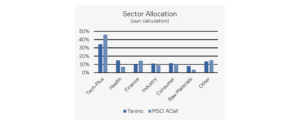
We consider this weighting to be reasonable. It allows us to participate in the long-term AI trend without making the portfolio entirely dependent on the future course of a single investment wave.
Step 2: Manage Risks
Over the past two months, we have taken profits on several occasions as AI-related stocks have risen sharply and have actively reduced our allocation. In such market phases, we view rebalancing not as an administrative task, but as a key factor for success. It forces us to maintain discipline when euphoria is at its peak.
Step 3: Diversify Risks
In addition to regular rebalancing, we deliberately focus on investments that do not move exclusively in step with the AI investment cycle. At the asset allocation level, these include core infrastructure, short-term bonds, gold, and cryptocurrencies. Within our equity allocation, we also favor defensive sectors, water, small-cap stocks, and markets with lower AI concentration, such as Europe, the United Kingdom, and Japan.
The composition within the technology sector is also important. The major indices are heavily dominated by semiconductors and hardware. We have deliberately chosen a broader allocation. This allows the portfolio to continue benefiting from technological change without taking on excessive exposure to any single stock.
Conclusion
Artificial intelligence remains a structural growth driver in which we intend to maintain a long-term stake. However, as its importance to the economy and financial markets grows, so does the responsibility to manage and calibrate this exposure in a targeted manner.
Our approach: To capitalize on long-term potential, discipline-driven correction of market excesses, and structuring portfolios so that they remain robust even as market leadership shifts.

Imprint
Tareno AG, Gartenstrasse 56, CH-4052 Basel, +41 61 282 28 00
Tareno AG, Claridenstrasse 34, CH-8002 Zurich, +41 44 283 28 00
info@tareno.ch
www.tareno.ch
Responsible
Simon Lutz
Chief Investment Officer
s.lutz@tareno.ch
Disclaimer
The statements and information in this publication have been compiled by Tareno AG to the best of its knowledge, in part from external (publicly accessible) sources which Tareno AG considers to be reliable, for information purposes only. This publication is not the result of a financial analysis. Tareno AG and its employees are not liable for incorrect or incomplete information or for losses or lost profits resulting from the use of information and the consideration of opinions expressed. The statements and information do not constitute a solicitation or invitation, offer or recommendation to buy or sell any investment instruments or to engage in any other transactions.
Nor do they constitute a specific investment proposal or other advice on legal, tax or other issues. A positive return on an investment in the past is no guarantee of a positive return in the future. The statements, information and opinions expressed herein are current only as of the date of this document and are subject to change at any time.
Duplication or reproduction of this publication, even in part, is not permitted without the written consent of Tareno AG. The “Guidelines for Ensuring the Independence of Financial Research” of the Swiss Bankers Association do not apply.
Images: Marijke Vosmeer, IStock, Pixabay, Unsplash, Lucia Hunziker
Charts: Tareno AG