Tareno View October 2026
The Hidden Bear Market
The major stock indices are near their record highs. But beneath the surface, rising interest rates worldwide have left a clear mark. Large segments of the stock market have corrected, while a few large-cap tech stocks are propping up the indices. This suggests that the recalibration of interest rate expectations has now been largely priced in. At the same time, the economy and corporate earnings remain robust. These are not bad conditions for rising stock prices. In our view, however, the challenging environment calls for greater selectivity in stock picking and a broader asset allocation.
Macroeconomic environment
Inflation and Debt Drive Up Interest Rates
The yield on 10-year U.S. Treasury bonds rose from 4.4% to 5.3% in the third quarter, reaching its highest level in many years. A significant portion of this rise in interest rates is homegrown: The U.S. budget deficit is projected to reach just under 6% of GDP in 2026, which is an exceptionally high figure for an economy that continues to grow. At the same time, energy prices—which have risen sharply as a result of the Iran conflict—have reignited inflation.
The U.S. is not alone in facing this problem. European gas prices have more than doubled since the beginning of the year. The longer energy markets remain tight, the greater the risk that the initially energy-driven price surge will spread to broader goods and services prices and cause inflation expectations to rise.
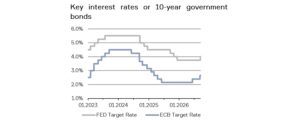
To prevent such second-round effects, central banks are once again adopting a more restrictive stance. In September, the Federal Reserve raised its benchmark interest rate for the first time since 2023. The European Central Bank raised its benchmark interest rates for the second consecutive time.
Economy Remains on Track
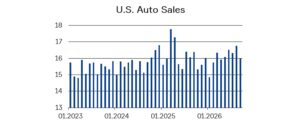
Despite high interest rates and energy prices, the real economy is holding up remarkably well. The majority of leading economic indicators continue to signal expansion. In the eurozone, industrial production grew in September for the third consecutive month, and the Purchasing Managers’ Index reached 52.9—its highest level in more than four years. In the U.S., consumer spending—which is particularly important there—is also proving surprisingly resilient. Car sales are a prime example of this: Despite higher vehicle prices, financing costs, and gas prices, sales figures remain robust.
The expansion of AI infrastructure continues to be a key driver of growth. At the same time, growth is becoming more widespread. By mid-year, positive revenue and profit trends were evident across numerous regions and sectors. The upcoming earnings season will show whether this trend continues and whether companies can maintain their margins despite higher energy and financing costs.
Market commentary
The Bear Market Lurking Beneath the Surface
At first glance, the stock markets seem to be taking the rise in interest rates in stride. At the end of September, the global stock market remained near its all-time high. One might conclude from this that investors are largely ignoring the higher interest rates.
However, a closer look reveals a different picture. This is particularly evident in the U.S.: While the market-capitalization-weighted S&P 500 declined only slightly in September, its equally weighted counterpart lost 4.4%. 78% of the index components posted price losses over the course of the month, and 42% were trading more than 20% below their respective 52-week highs at the end of September.
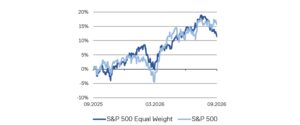
The “bear market” is therefore not taking place at the index level, but rather “hidden” across large parts of the stock market. The strength of the major indices is concentrated in a few heavyweight technology companies. Their structural growth, high margins, and strong balance sheets make them less vulnerable to rising financing costs. Smaller companies, highly indebted firms, and interest-rate-sensitive business models, on the other hand, are feeling the impact of higher cost of capital much more acutely.
Much of the headwind has already been priced in
The weakness of the broader stock market shows that investors are by no means ignoring the changed economic conditions. The interest rate market is also already pricing in several rate hikes.
At the same time, earnings estimates have continued to rise. The combination of broad-based price declines and higher earnings expectations has therefore led to a noticeable valuation correction. In the S&P 500, the expected price-to-earnings ratio has fallen from just over 22 to around 19 since the beginning of the year.
This has strengthened the foundation for the coming months. If energy prices and interest rates stabilize and the earnings season confirms the positive profit trend, there is potential for a rebound, particularly in the market segments that have recently lagged behind.
A Weak Franc as an Opportunity
The particularly sharp rise in U.S. yields has widened the Swiss franc’s interest rate disadvantage. This increases the attractiveness of the U.S. dollar in the short term and has recently weakened the franc.
This does little to change our cautious long-term outlook on the U.S. dollar. In our view, high budget deficits, higher inflation than in Switzerland, and the currency’s continued ambitious valuation point to long-term upward pressure on the Swiss franc. We therefore view the dollar’s current strength as an opportunity to partially hedge USD risks and increase the CHF allocation in the portfolio. Especially during periods of heightened market uncertainty, the Swiss franc is likely to prove once again to be a valuable stabilizer.
Positioning
Confident, but Selective
In summary, we continue to view the risk-reward ratio in the stock markets positively. A significant portion of the rise in interest rates has now been priced in, while corporate earnings continue to grow and are becoming more widespread. We are also encouraged by the fact that we continue to find numerous high-quality companies in attractive business sectors at reasonable valuations.
However, the market environment has become less forgiving. Rather than counting on the broad market to continue its upward trend, stock selection, valuation, and diversification are becoming increasingly important to us.
Quality Over Beta
Higher interest rates are creating a sharper distinction between robust and vulnerable business models. High-quality companies have solid balance sheets, strong free cash flows, and pricing power. They are less reliant on cheap refinancing and are better able to absorb rising costs.
After years in which growth and size were the primary factors rewarded, we therefore see favorable conditions for greater differentiation based on quality and valuation. That is precisely where the focus of our stock selection lies.
Take Advantage of the Concentration
The pronounced divergence between a few index heavyweights and the broader market presents opportunities. We recommend taking advantage of this to reduce dependence on individual technology stocks and sectors and to make targeted investments in attractive companies outside the current group of winners.
For us, diversification does not mean owning as many securities as possible, but rather incorporating different sources of return into the portfolio.
Bonds Are Back
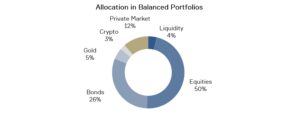
Following the sharp rise in yields, bonds are once again an attractive addition to balanced portfolios, particularly for investors with EUR and USD as their reference currencies. In our view, medium-term corporate bonds with high credit quality combine an attractive current yield with limited interest rate risk.
Alternative Investments as a Safety Net
Our base case remains a robust global economy with rising corporate earnings. However, a resilient portfolio must also be able to withstand scenarios in which high energy prices persist for longer, inflation regains a foothold, or growth slows more sharply.
Here, we see added value in carefully selected alternative investments. Infrastructure benefits from inflation-linked returns, gold offers stability during confidence, inflation, and currency shocks, and a small allocation to cryptoassets promises asymmetric potential.
Conclusion
The recent market shifts present an opportunity to reduce concentration risks in technology and the U.S. dollar and to tap into additional sources of return outside the stock market.

Legal Notice
Tareno AG, Gartenstrasse 56, CH-4052 Basel, +41 61 282 28 00
Tareno AG, Claridenstrasse 34, CH-8002 Zurich, +41 44 283 28 00
info@tareno.ch
www.tareno.ch
Contact
Simon Lutz
Chief Investment Officer
s.lutz@tareno.ch
Disclaimer
The statements and information in this publication have been compiled by Tareno AG to the best of its knowledge, in part from external (publicly accessible) sources which Tareno AG considers to be reliable, for information purposes only. This publication is not the result of a financial analysis. Tareno AG and its employees are not liable for incorrect or incomplete information or for losses or lost profits resulting from the use of information and the consideration of opinions expressed. The statements and information do not constitute a solicitation or invitation, offer or recommendation to buy or sell any investment instruments or to engage in any other transactions.
Nor do they constitute a specific investment proposal or other advice on legal, tax or other issues. A positive return on an investment in the past is no guarantee of a positive return in the future. The statements, information and opinions expressed herein are current only as of the date of this document and are subject to change at any time.
Copying or reproducing this publication, even in part, is prohibited without the written consent of Tareno AG. The “Guidelines for Ensuring the Independence of Financial Analysis” issued by the Swiss Bankers Association do not apply.
Images: Marijke Vosmeer, iStock, Pixabay, Unsplash, Lucia Hunziker
Charts: Tareno AG