Rebalancing Portfolios
June 10, 2026
Is the AI rally over?
We view the current price correction among AI beneficiaries as a healthy consolidation following strong price gains, not as a trend reversal. The price increases of recent months were not purely speculative, but were fundamentally supported by impressive earnings growth. For 2026, earnings growth of over 30% is expected for stocks in the AI universe.
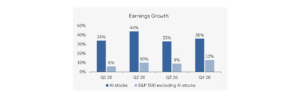
As demand for AI applications is growing rapidly, we expect the expansion of AI infrastructure to continue and earnings growth to persist. Data centers, semiconductors, power supply, and digital infrastructure remain key components of this investment cycle, which is set to continue for several more years.
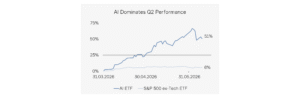
Time to rebalance
As optimistic as we remain about the long-term prospects for AI, profit and share price growth at the current pace is not sustainable. Sooner or later, the expansion of margins at semiconductor companies will reach its limits and return to normal.
In line with our philosophy of countercyclical rebalancing, we therefore believe it is appropriate to reduce our positions in overheated market segments. We have already implemented this strategy over the past month by selling Qualcomm and partially divesting our holdings in ABB and Alphabet.
This recommendation comes just a few weeks after we identified a buying opportunity in the technology sector in early April. This clearly illustrates the extent of the current sector rotation and the opportunities it presents for active managers.
Prepare for greater volatility
Looking ahead to the coming months, the stock markets are set to face several stress tests.
First, the restricted shipping traffic through the Strait of Hormuz is causing bottlenecks in the supply of crude oil, liquefied natural gas, and petrochemical feedstocks. This threatens to result in longer delivery times and declining inventory levels in downstream industries.
Second, as a direct result, inflation rates are rising globally. In the U.S., they are expected to exceed 4%. This is hardly an environment in which the Federal Reserve can cut interest rates quickly, especially since the labor market remains in good shape.
Third, the supply of capital is set to increase significantly in the coming months as fresh funds are raised on the capital markets. Additional bond issuances by governments and corporations could push up long-term interest rates and limit valuation potential in the stock markets.
These short-term headwinds have led us to refrain from reinvesting all of our realized gains and to reduce the equity allocation back to a level close to its initial weighting at the start of the year.
What’s going on with crypto assets and gold?
Gold and cryptocurrencies are also suffering amid rising interest rate expectations and the capital market’s strong focus on AI. Gold has given up the gains of around 20% it had made since the start of the year. Bitcoin and Ethereum have seen even steeper corrections.
Since the structural factors underlying both asset classes remain intact (high government debt, long-term inflation, and growing geopolitical risks), we are maintaining our positions.
Conclusion regarding our investment strategy
We remain invested in the AI sector for the long term, but are making targeted adjustments to reduce concentration risk and improve the portfolio’s balance. Given the solid economy and strong earnings growth, we are confident about the second half of the year and believe we are well positioned with our diversified portfolio and high-quality equity investments.

Do you have any questions on this topic?
Our portfolio management team will be happy to provide you with explanations and clarifications.
Find out more about us
Wealth Management
Publications